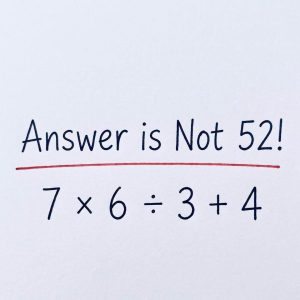
The equation 7 × 6 ÷ 3 + 4 might look like a straightforward arithmetic problem, but it offers a useful reminder about the order of operations. This mathematical principle determines which calculations must be completed first when an expression contains different operations. Without an agreed order, people could interpret the same equation differently and produce conflicting answers. Many of us learned the rule through the abbreviation PEMDAS, which stands for Parentheses, Exponents, Multiplication, Division, Addition, and Subtraction. Others learned BODMAS, a similar method used in many classrooms. Both systems follow the same fundamental mathematical principles.
The important detail is that multiplication and division have equal priority. Contrary to a common misunderstanding, multiplication does not always come before division simply because it appears first in the PEMDAS abbreviation. When multiplication and division appear together, they must be calculated from left to right. Addition and subtraction also share equal priority and follow the same left-to-right rule. In this puzzle, there are no parentheses or exponents, so we can begin directly with multiplication and division. Understanding this small distinction makes solving the equation much easier and prevents mistakes that can happen when someone rushes through the calculation.
Now let’s solve the puzzle carefully. We begin with 7 × 6 ÷ 3 + 4. First, multiply 7 by 6, which gives 42. The expression becomes 42 ÷ 3 + 4. Next, divide 42 by 3, giving 14. Now the equation is reduced to 14 + 4. Finally, add 14 and 4 to obtain 18. That is the correct answer. The calculations themselves are simple, but following the correct order is essential. Anyone who groups the numbers differently without parentheses may arrive at another result, but that would not follow the standard rules for interpreting the original expression.
Math challenges like this remain popular because they encourage people to think before responding. They also remind adults of lessons learned many years ago in school. Whether you studied arithmetic with chalkboards, textbooks, or modern classroom technology, the same rules still apply. Solving these puzzles can be an enjoyable way to practice attention and reasoning, especially when sharing them with family or friends. And if you didn’t get the right answer immediately, there’s no reason to feel embarrassed. A simple review of the order of operations can make the next puzzle much easier. Sometimes, the smallest mathematical details are the ones that matter most.
🧠 Be honest! What answer did you get before reading the explanation — 18 or something else? Write your first answer in the comments!




This Post Has One Comment